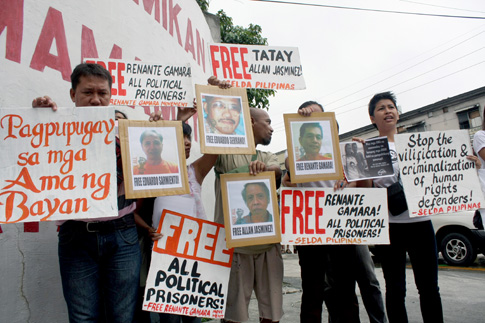
A Political Prisoner’s Fathers’ Day
Sa Araw ng mga Ama, naglabas ng mga sanaysay at isang awit ang apat ng bilanggong pulitikal na kasalukuyang nakadetine sa Camp Crame Custodial Center. Sila ay mga konsultant ng National Democratic Front of the Philippines na hindi pa rin pinalalaya ng gobyernong Aquino. Sila rin ay mga ama na nawalay sa kani-kanilang mga anak dahil […]

Sa Araw ng mga Ama, naglabas ng mga sanaysay at isang awit ang apat ng bilanggong pulitikal na kasalukuyang nakadetine sa Camp Crame Custodial Center. Sila ay mga konsultant ng National Democratic Front of the Philippines na hindi pa rin pinalalaya ng gobyernong Aquino. Sila rin ay mga ama na nawalay sa kani-kanilang mga anak dahil sa pagkakapiit. Inilalathala ng Pinoy Weekly ang kanilang mga sulatin at likhang sining ngayong Araw ng mga Ama.
***
As father’s day passes and I remain a political prisoner (presently in the 16th month of my third imprisonment, and the 115th or almost 10 years of the total time I have so far behind bars), I recall the close four decades I have been greatly distanced physically at least, as well as I terms of other practical and secure means of communication from my two sons, Carlos Andres (“Dimpy”) and Arthur Victor.
Hardly a year after I gained freedom in late 1977 from my first martial law detention, I could not help but notice the ruling state’s military police and intelligence’s continuous surveillance of me as being too close for comfort. I observed, for one, that at the second floor of an apartment unit across the street, there was a mounted camera constantly focused at our house in Sampaloc, Manila. The windows were noticeably newly heavily tinted but in the early mornings and late afternoons when the sunlight was oblique and its reflections weak, the mounted camera right behind the tinted windows could be discerned.
I thus decided it was safer for me and more fruitful for my work in the national democratic revolutionary movement if I would no longer remain aboveground and an easy target of foul play, especially as there continued to be many victims of extra judicial killings and other fascist acts.
Having already noticed long before that we could discuss very intelligently even in their early years ( Dimpy was then seven; Arthur, five), I talked intimately and seriously with my two sons. I explained everything to them in the context of the ongoing war between the filthy rich and the exploited and oppressed poor and miserable. I told them that the army of the poor and miserable would require my full time work and my problem with the armt of the rich and powerful required to become unavailable as a target of the latter in the open.
They were serious in our talk, and thought deeply about everything I was saying. They asked me many incisive questions like the difference between the rich and the poor, which I described in the simplest terms I considered they could understand. I shared with them the cause I have been fighting and sacrificing so much for.
I could see from their questions and their noddings and through their eyes that what we’re talking about sank deep in their thoughts. I could see that they could understand everything I was explaining, appreciated the works I have been devoting myself to and respected the step I was taking.
I did not realize how deeply their understanding of what I am and what I am doing have sank into them, until sometime later when it came to a point that one of them vehemently objected to his elementary school teacher’s writing on the blackboard “Rebels are bad.” My son stood up in protest and walked out saying loudly “My father is a rebel and he is not bad.”
I first noticed about the teacher herself when I later made a surprise visit to my sons at their Lourdes School in La Loma, Quezon City and chanced upon her alone in my son’s classroom. It was break time and the boys were not in their classrooms. I introduced myself to the teacher who expressed surprise on my surprise visit and very eagerly helped to look for my sons until we found them having snacks at the school cafeteria. The teacher smiled happily at my reunion with my sons.
Sometime later, I learned from the boys’ mother the whole story. Right after my son’s protest at what was written on the blackboard, the teacher called for the mother to report and talk about the incident. After the explained what was behind the son’s objection to what the teacher wrote on the blackboard, the teacher was able to understand the whole thing which was why she was very glad and helpful when we met in my son’s classroom and together we looked around for the two brothers that break time.
For a number of years decades ago, i would my sons once in a while except when I would stay quite long in a distant countryside.
But for more than a dozen of years before this latest imprisonment of mine, I haven’t been able to personally meet with my sons. The most I could do was send them letters even if replies were few and far between.
It was because my family was under very close surveillance, family members’ telephone lines were all bugged. A later departed younger brother who was going to our Parang, Marikina family residence at 2 am noticed a pair of intelligence agents posted at a jeepney stop nearest our residence. My mother noticed that she was constantly tailed wherever she goes to. An adopted brother was even abducted, tortured for a couple of days and just dropped along a street with red, black and blue marks all over his body due to severe beatings he received. The fascists tried to extract information from him if I had, at any time, met with my family. They were, however, not able to make him talk, not only because he is a deaf-mute but also because I had, in fact, not met with the family for decades.
It is only now, in my current imprisonment, that I have been able to see my sons and other family members after decades of not having seen them.
Although because of work and other circumstances (one is living abroad), my sons are not able to visit often. I am touched by the understanding, respect, sympathy and love that they continue to give despite the fact that they grew up without me since their toddler years.
Someone wrote to me when one of my sons (Dimpy) read a message at the opening of our Painting Freedom at the Sining Kamalig art gallery, his reading of our message was a “stupendous, oratorical delivery” that made a strong impact to those who were present and heard it.
At the celebration of my mother’s 91st birthday, on the eve of my first anniversary of my present detention, my other son, Arthur, was the one who read my letter to his lola which touched her a lot.
I feel very grateful for the respect and love my sons continue to give their dad even after decades of having been an absentee father and for the support they show now when their dad has ince again become a political prisoner.
This feelings serves as an oasis in midst of their repressions, hardships and struggles I and more than 350 other political prisoners continue to suffer under the prevailing, unjust, rotten, impoverished and repressive system that needs to be radically changed to a liberated, democratic, just, modern, pro-people and progressive system in the country.
In the face of sacrifice, we remain resolute in our struggles for such radical social changes for the sake of our people and our people’s sons and daughters.
Alan Jazmines
NDF peace consultant detained at the PNP Custodial Center, Camp Crame
17 June 2012